

Plinko is a ball-drop format: a ball falls from the top and, bouncing off rows of pegs, lands in a slot with a multiplier that is applied to your bet. As a game it appeared in 1983 on the TV show The Price Is Right, while its ‘ancestor’ is the 19th-century Galton board.
We’ll break it down neutrally and in detail: how the math works, what rows and the risk level change, how provider versions differ, and why high RTP and multiplier figures are not a promise of winning.
Key takeaways
- Plinko is a ball-drop format: a ball falls through pegs into a slot with a multiplier.
- At its core are the Galton board and the binomial distribution: the centre is more likely (small multipliers), the edges are rare (large ones).
- The number of rows (8–16) and the risk level change the spread of multipliers and the variance, but NOT the chance of hitting an edge.
- Provider versions differ: BGaming — up to 99% and ×1000; Spribe — around 97% and ×555.
- Many versions are provably fair: the fairness of a round can be verified, but that does not remove the risk. 18+, risk of loss.
What Plinko is and where it came from
A ball falls from the top and, bouncing off rows of pegs, lands in one of the slots at the bottom; that slot’s multiplier is applied to your bet. As a game, Plinko appeared in 1983 on the TV show The Price Is Right, while the physical device has been known since the 19th century as the Galton board (bean machine), introduced in 1874 to demonstrate the laws of probability.
It reached the online format in the crypto segment: the platform Stake made a provably fair version, and one of the most widespread variants was released by BGaming (the game page is dated 28 January 2019). Plinko is also made by Pragmatic Play (Plinko+), Spribe, SmartSoft Gaming, Turbo Games and others.
Math: the Galton board and the binomial distribution
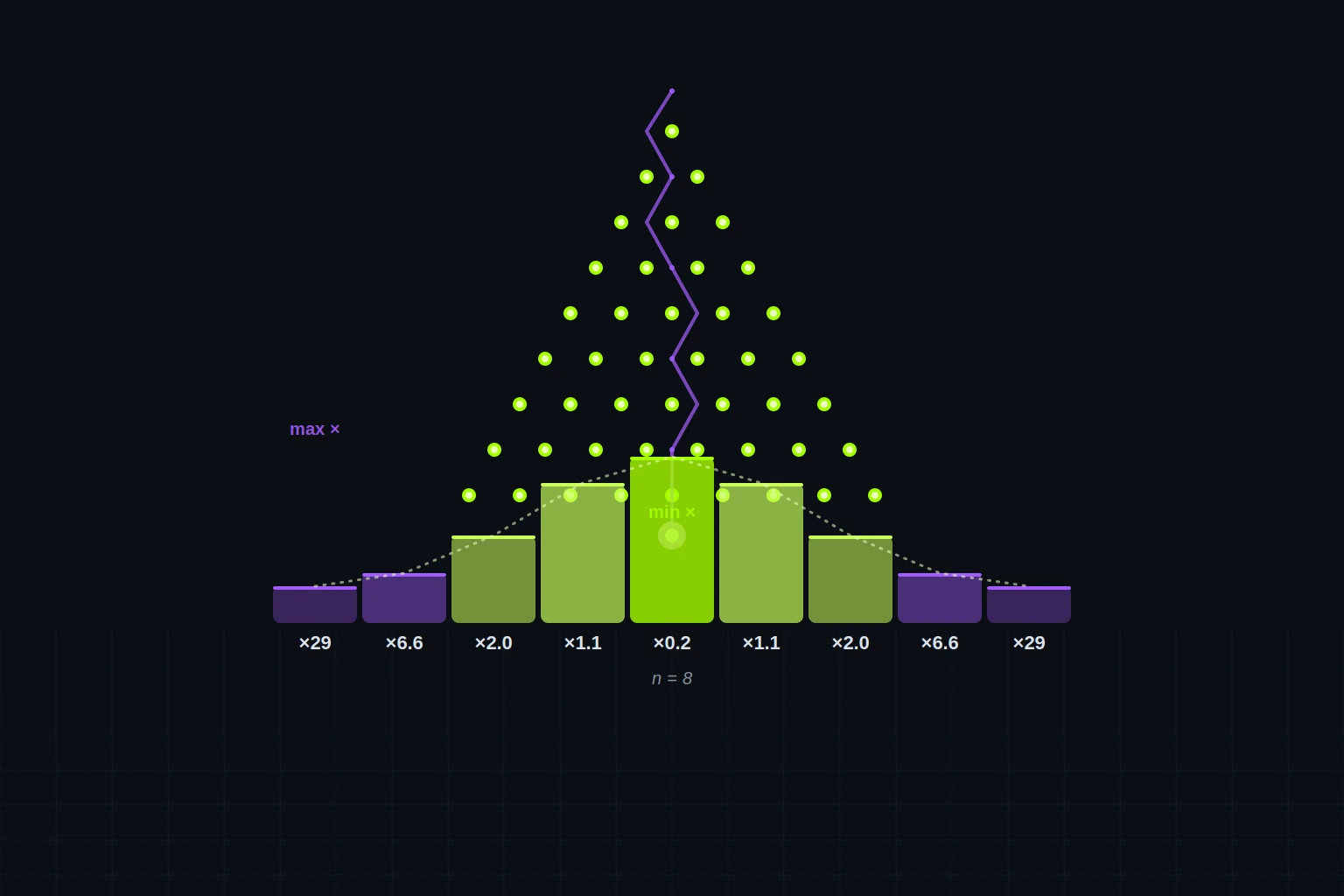
At each row of pegs the ball goes left or right with roughly equal probability. The final slot depends on how many times it went right, and the number of paths to it is described by Pascal’s triangle. That is why many paths lead to the centre (the ball lands there more often), while only one leads to the very edge (it comes up extremely rarely).
Hence the ‘inverted’ layout: near the centre the multipliers are modest (often below ×1), at the edges they are large and rare. The more rows there are, the more rarely an edge comes up:
| Rows | Slots at the bottom | Chance of hitting the very edge |
|---|---|---|
| 8 | 9 | ~1 in 256 (≈0.39%) |
| 12 | 13 | ~1 in 4,096 (≈0.024%) |
| 16 | 17 | ~1 in 65,536 (≈0.0015%) |
Rows and risk levels: what they change
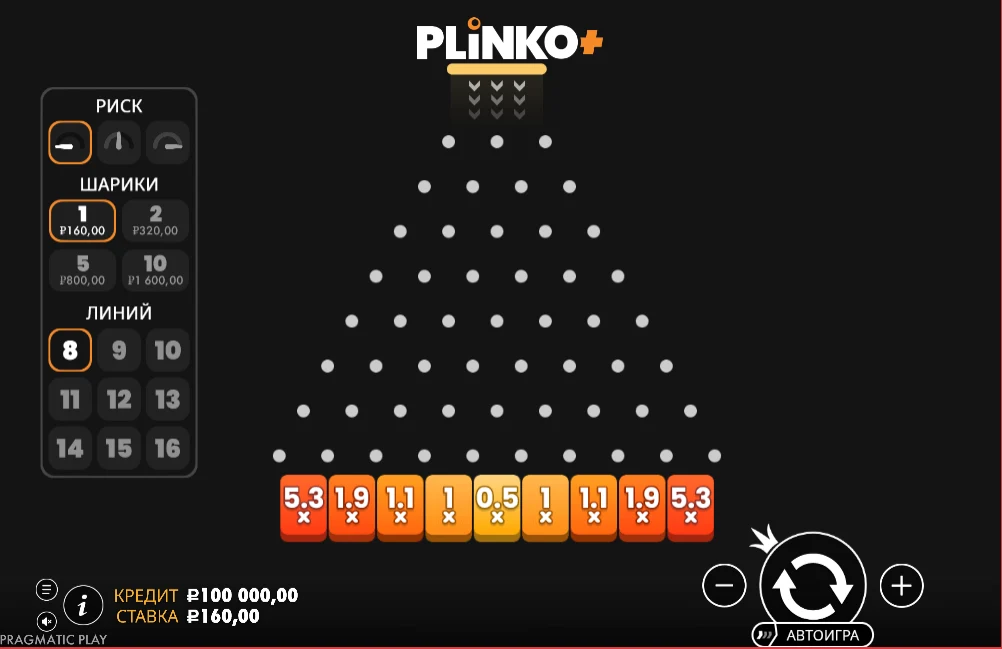
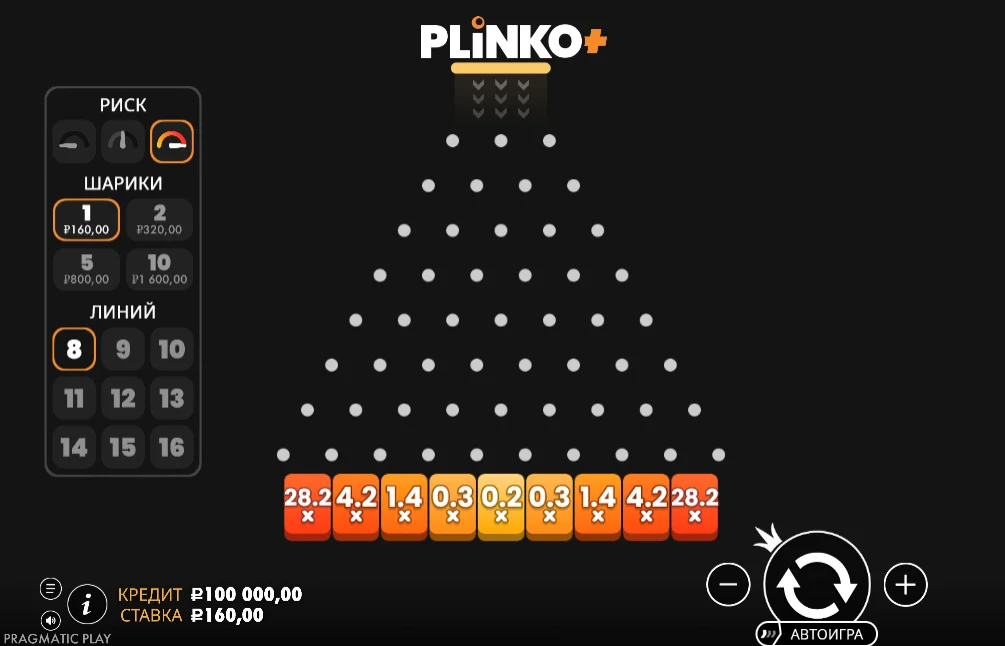
The player usually sets the number of rows and the risk level. Switching the risk does not change the probabilities of landing in the slots — those are set by the board. Risk only reshapes the multiplier table and the variance: on high risk the centre multipliers are lower, while the edges are higher and rarer.
This is clearly visible in a real layout. In the Plinko+ version, on 8 rows at low risk the edge slots are around ×5.3 and the centre is ×0.5. At high risk the same 8 rows give an edge of ×28.2 and a centre of ×0.2; and on 13 rows at high risk the edge reaches ×254.8. More rows and higher risk mean a wider spread, but NOT a higher chance of hitting an edge.
| Risk level | How the multipliers behave | Profile |
|---|---|---|
| Low | Closer to ×1; modest edges | Small spread, frequent small outcomes |
| Medium | A balance of centre and edges | Moderate spread |
| High | Centre often <×1, edges rare and large | High variance — not a higher chance, but a wider spread |
Plinko versions from different providers
Plinko is not a single game but a format; versions differ in return and ceiling. Focus on the RTP of the version, not on the maximum in the advertising; an operator may set a reduced RTP.
| Provider (version) | RTP | Max. multiplier |
|---|---|---|
| BGaming (Plinko) | up to 99% | ×1000 |
| Stake (original) | ~99% | ×1000 |
| Spribe | ~97% | ×555 |
| SmartSoft (PlinkoX) | 98.5% | ×10,000 |
Provably fair: how to check fairness
Many versions (including Stake) use provably fair: a server seed (its hash is shown before the bet), a client seed (which you can change) and a nonce (a bet counter). After the round, the casino reveals the server seed, you compare its hash with the one shown in advance and recompute the result from the combination of server seed + client seed and nonce.
Provably fair confirms the fairness of how the result was generated, but it does not change the fact that the game remains a wager with risk and a negative expected value for the player.
What this means for the player
Plinko is a game of chance, not skill: there are no ‘strategies’ that raise your chances here, and auto mode only speeds up your bets and how fast you spend. Focus on the version’s RTP and the risk level, not on the maximum multiplier at the edge — it is rare by its very nature.
A simple, fast pace makes it easy to lose control of your budget — limits and breaks help. Treat Plinko as entertainment that carries risk. Enter Jetton Casino.
This material is for informational purposes. Gambling is 18+, involves the risk of losing the entire amount deposited and is not a way to earn money. Plinko is a game of chance: the risk level changes the spread but does not increase the chance of winning; RTP is a statistic over the long run, not a guarantee. Play responsibly and use limits and self-limitation tools.
More on Radar
Frequently asked questions
What is Plinko?
A ball-drop format: a ball falls through pegs into a slot with a multiplier that is applied to your bet. At its core is the Galton board.
Why does the ball hit the centre more often and the edge rarely?
It’s the binomial distribution: many paths lead to the centre and only one to the edge, so the edge comes up extremely rarely.
Does ‘high risk’ change the chance of winning?
No. It only changes the spread of multipliers and the variance; the probabilities of landing in the slots are set by the board.
Do all Plinko games have the same RTP?
No. It depends on the provider and version (BGaming — up to 99%, Spribe — around 97%), and an operator may set a reduced one.
What is provably fair?
A mechanism for verifying that the result was not swapped after the bet (server seed and client seed plus a nonce). It confirms fairness but does not remove the risk.
Sources
- BGaming — Plinko (game page) — bgaming.com
- gamblingcalc — Plinko probabilities and multipliers — gamblingcalc.com
- Wikipedia — Galton board — en.wikipedia.org
- Stake — provably fair implementation — stake.com
- Wikipedia — Plinko (The Price Is Right) — en.wikipedia.org