

Jeton is an international e-wallet (its site is jeton.com) you can use to make deposits and cash out winnings at online casinos and bookmakers. It’s important not to confuse two similar names: Jeton with one “t” is a payment service, while Jetton with two “t” is an online casino. This article is about the Jeton wallet as a payment method, not about the casino.
Below, with no marketing spin: what Jeton actually charges to top up and withdraw, which limits apply, how verification works, why a withdrawal sometimes seems to “stall” in Pending status, and how Jeton differs from Skrill and Neteller. The figures come from jeton.com, the Jeton help centre and specialist reviews; rates depend on the country and the method, so always check the final fee in your own account before you make a transaction.
Key takeaways
- Jeton (one “t”) is the jeton.com wallet; Jetton (two “t”) is a casino. They are different services.
- Jeton itself usually charges no fee to deposit or withdraw at a casino — what you pay for is topping up or cashing out the wallet itself.
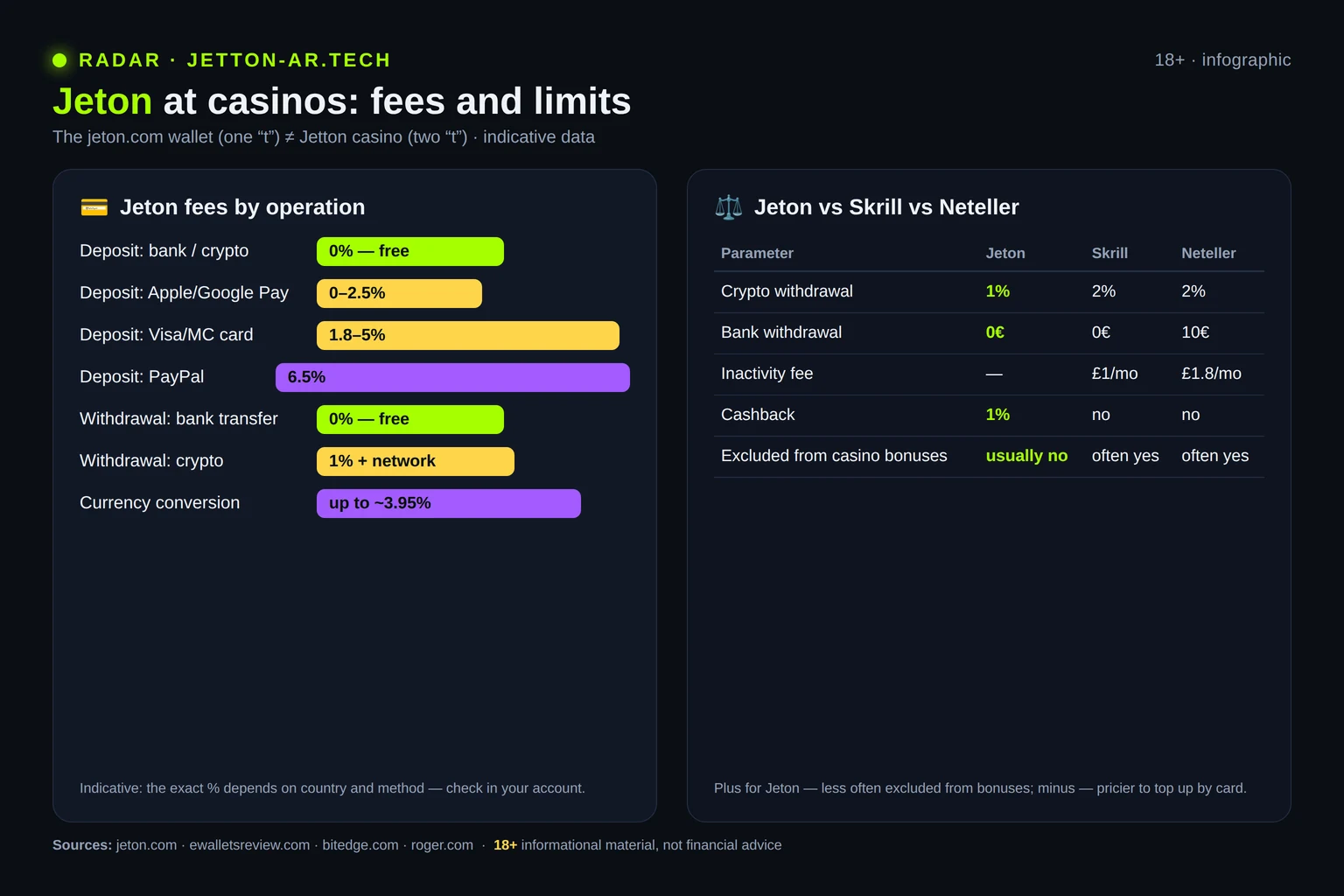
- Cheap ways to fund the wallet: bank transfer and crypto (0%); the expensive ones are card (≈1.8–5%) and PayPal (6.5%).
- Withdrawals to a bank carry no Jeton fee; a crypto withdrawal costs 1% plus the network fee.
- A withdrawal goes through verification (KYC) and can take up to 2 business days — that’s normal, not a “scam”.
- 18+. This is informational content; gambling carries the risk of losing money, and crypto adds price and network risk.
Jeton is a wallet, not a casino
Jeton Ltd is a British payment company that has operated since 2017. The wallet is regulated by the FCA in the UK and holds approval from the Central Bank of Cyprus to operate in the EU; the service carries ISO 27001 and PCI DSS Level 1 security certifications, and client funds are held in segregated accounts. Two-factor authentication and biometrics are available for sign-in.
Functionally it’s a multi-currency e-wallet: it supports more than 50 fiat currencies and 7 cryptocurrencies (BTC, ETH, LTC, BCH, DOGE, XRP, USDT), and the wallet itself can be funded in dozens of ways. In the casino cashier Jeton acts as one of the payment methods: you move money from your wallet balance to your casino account and back.
One more word on the names, because this trips people up so often: Jeton (jeton.com, one “t”) is a payment wallet; Jetton (two “t”) is an online casino. If you’re depositing with the Jeton wallet specifically at the Jetton casino, sign in to your account on the Enter Jetton Casino page.
Jeton products: Wallet, Cash and Card
The Jeton brand covers several products — and it helps to tell them apart, because their fees and use cases differ.
| Product | What it is | The catch |
|---|---|---|
| Jeton Wallet | The main wallet (web + iOS/Android app) | KYC is mandatory to withdraw |
| JetonCash | Prepaid vouchers with a face value of €5–€250 | Redeeming a voucher into the wallet is free; from third-party sellers the voucher costs more than its face value |
| Jeton Card | A virtual and physical Visa/Mastercard | The physical card is issued only to EEA residents; annual fee ~€10 (waived with turnover of €10 000/year or more) |
Jeton fees: where you pay and where you don’t
The key principle: as a rule, Jeton doesn’t charge a separate fee for paying at a casino or for receiving a withdrawal from a casino back into the wallet. Costs arise at the “edges” — when you move money into the wallet and when you take it out of the wallet to a card, a bank or crypto. So how cheap Jeton is depends on the methods you use to top up and withdraw.
According to reviews and Jeton’s own help pages, topping up by card is the most expensive of the non-crypto methods, while bank transfer and crypto transfer are usually free. Below is an indicative matrix; the exact percentages vary by country, so check them in your own account.
| Transaction | Jeton fee | Per-transaction limit |
|---|---|---|
| Top-up: bank transfer | Free | €10–€10 000 |
| Top-up: cryptocurrency | Free | from €50 |
| Top-up: Visa/MC card | ≈1.8–5% (depends on region) | €5–€1 000 |
| Top-up: Apple/Google Pay | 0–2.5% | €10–€1 500 |
| Top-up: PayPal | 6.5% | €10–€500 |
| Withdrawal: bank transfer | Free | €50–€15 000 |
| Withdrawal: cryptocurrency | 1% + network fee | ≈€300–€15 000 |
| Jeton → Jeton transfer | Free | — |
| Currency conversion | up to ~3.95% (spread) | — |
Limits: how much you can deposit and withdraw
Limits depend on the method and on the level of verification you’ve completed. Ballpark figures from reviews: a bank withdrawal is €50–€15 000 per transaction, a crypto withdrawal roughly €300–€15 000. Some sources cite a wallet “balance ceiling” of around €12 000, but this isn’t confirmed officially and probably applies to a specific card tier rather than to all accounts — don’t treat it as a hard rule.
The practical takeaway: for large amounts it makes sense to complete full verification in advance and confirm your limits with support, rather than running into them at the moment you cash out your winnings.
Depositing and withdrawing at a casino: how it works
A deposit via Jeton looks like this: in the casino cashier you choose Jeton, enter the amount, confirm the transaction (usually with 2FA) — and the money is credited within minutes. Withdrawing from a casino to a wallet isn’t supported by every wallet, but Jeton does accept withdrawals: once the casino approves, funds often reach the wallet quickly and with no fee on Jeton’s side.
A useful point in Jeton’s favour: unlike Skrill and Neteller, which many casinos exclude from welcome bonuses, deposits via Jeton usually do count towards bonuses. This is worth checking in each casino’s rules, but statistically Jeton lands on the list of excluded methods less often.
- In the casino cashier, choose Jeton as the payment method.
- Enter an amount within the limits and confirm the transaction (2FA).
- The deposit is credited within minutes; a withdrawal is first processed by the casino, then the money arrives in the wallet.
- To get the money in hand, withdraw it from the Jeton wallet to a bank, card or crypto — this is where the withdrawal-method fee comes in.
Verification (KYC) and why a withdrawal “stalls”
To withdraw, Jeton requires verification: a photo of an ID document (passport/residence permit/driving licence), proof of address (a utility bill) and sometimes a bank statement showing your name and address. Documents must be recent (usually no older than 3 months), free of glare and not cropped. According to Jeton, the check usually takes from 1 to 24 hours.
The withdrawal itself moves through stages: Pending (internal checks — the transaction can still be cancelled) → Waiting (processing, officially up to 2 business days) → Approved or Declined. It’s at these statuses that users get the feeling that the “withdrawal isn’t coming”. Most often the reason isn’t fraud but KYC checks and standard processing times.
What genuinely lowers the risk of a delay: complete verification in advance (not at the moment of your first withdrawal), make sure the name at the casino, in the wallet and on your bank account all match, and don’t exceed the limits. If a withdrawal is stuck longer than the stated times, that’s a reason to contact Jeton and casino support, not to panic.
Jeton versus Skrill and Neteller
Skrill and Neteller are the best-known e-wallets in gambling, so a comparison with them is the crux of the choice. The figures below are indicative (the Skrill/Neteller rates are taken from their public terms and from reviews).
| Parameter | Jeton | Skrill | Neteller |
|---|---|---|---|
| Inactivity fee | Not stated in the sources | £1/mo after 12 months | £1.80/mo after 14 months |
| Card deposit | ≈1.8–5% | Free (cards) | 2.5% |
| Withdrawal to a bank | Free | Free | €10 |
| Withdrawal to crypto | 1% + network | 2% | 2% |
| Cashback | 1% on payments | No fixed 1% | No fixed 1% |
| Excluded from casino bonuses | Usually NOT excluded | Often excluded | Often excluded |
Security, cashback and reputation
Jeton runs a loyalty programme: 1% cashback (Payin Cashback) on payments made through a Jeton account at partner sites; cashback isn’t earned on payments from bonus balances, and the exact promo limits are set out in its own terms. Separately, there are occasional regional promotions offering “up to 5%” on a first payment.
The wallet’s reputation is polarised: it has plenty of positive reviews and a noticeable share of negative ones — the typical complaints concern withdrawal delays, repeated document requests and the quality of support. That’s a normal profile for a payment service of this scale, but before large transactions weigh the risks soberly and keep a record of your correspondence with support.
And a key access restriction: Jeton operates in more than 100 countries, but there’s an official blocklist (including, for example, the US and a number of sanctioned countries), while the physical card is available only in the EEA. Check whether the service is available in your country before you move any money into it.
This content is informational and is not financial advice. Gambling is 18+ and carries the risk of losing all the money you deposit; an e-wallet has no effect on the outcome of a game and doesn’t “make it safer”. Crypto transactions add price and network risk. Play responsibly and only deposit amounts you can afford to lose.
More on Radar
Frequently asked questions
Are Jeton and Jetton the same thing?
No. Jeton (one “t”, jeton.com) is a payment wallet. Jetton (two “t”) is an online casino. The Jeton wallet can be used as a payment method at a range of casinos.
Does Jeton charge a fee to deposit at a casino?
As a rule, Jeton doesn’t charge a separate fee for the deposit itself or for receiving a withdrawal from a casino. What you pay for is topping up the wallet (by card, for example) and withdrawing from the wallet to a bank or crypto.
Why is my Jeton withdrawal in Pending/Waiting status?
These are the checking stages: Pending — internal checks (the transaction can be cancelled); Waiting — processing, officially up to 2 business days. The reason is usually verification, not a rejection.
What do you need for Jeton verification?
A photo of an ID document, proof of address and sometimes a bank statement; documents should be recent and free of glare. The check usually takes from 1 to 24 hours.
Jeton or Skrill/Neteller — which to choose?
It depends on the methods and your region. Jeton’s plus: it’s excluded from casino bonuses less often and has no explicit inactivity fee in the sources; its minus: topping up by card is more expensive. Check the rates for your own country.
Sources
- Jeton — Terms and Conditions (country list, restrictions) — www.jeton.com
- Jeton Blog — 1% Instant Cashback (cashback terms) — blog.jeton.com
- Jeton Blog — how to verify your account in the app — blog.jeton.com
- Jeton Help Desk — why a withdrawal is in Pending status — jetonhelp.zendesk.com
- eWalletsReview — Jeton Review 2026 (fees, limits, cashback) — ewalletsreview.com
- BitEdge — Jeton Wallet Review 2026 (limits and rates) — bitedge.com
- Roger.com — Neteller vs Skrill 2026 (rates for comparison) — www.roger.com